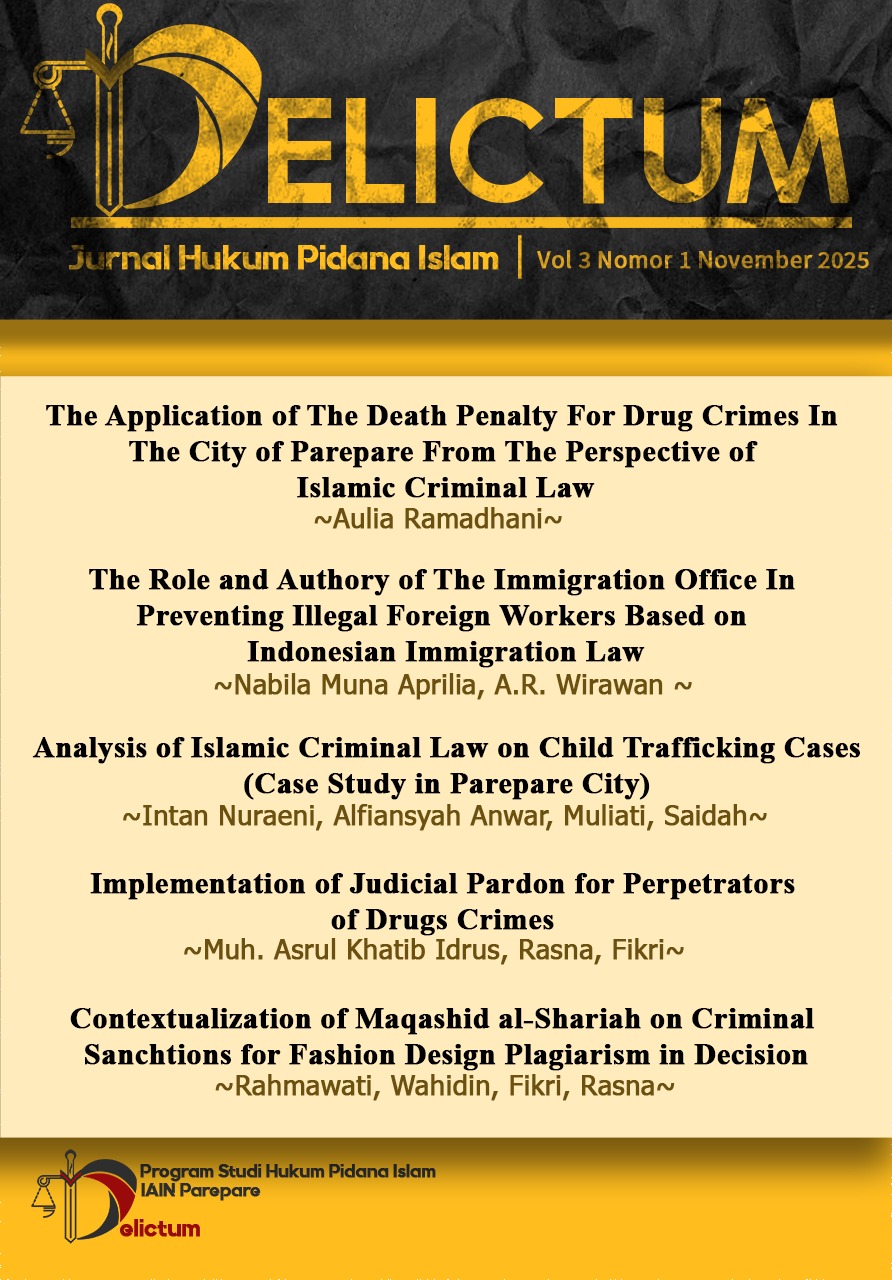
Kontekstualisasi Maqashid Al-Syariah Terhadap Sanksi Pidana Bagi Pelaku Penjiplakan Desain Busana (Analisis Putusan Nomor 1/Pdt.Sus-HKI/2020/PN Niaga Mks)
Analisis Hukum Islam Terhadap Pelanggaran Hak Kekayaan Intelektual dalam Desain Busana
DOI:
https://doi.org/10.35905/delictum.v3i1.15364Keywords:
• Hak Kekayaan Intelektual • Maqāṣid al-Syarī‘ah • Penjiplakan Desain Busana • Ta‘zīr • Keadilan Hukum Islam • Hifz al-Māl • Hukum Hak CiptaAbstract
Penelitian ini membahas mengenai kontekstualisasi maqāṣid al-syarī‘ah dalam pemberian sanksi pidana terhadap pelaku penjiplakan desain busana dengan menganalisis Putusan Pengadilan Negeri Makassar Nomor: 1/Pdt.Sus-HKI/2020/PN Niaga Mks. Tiga permasalahan utama yang dikaji yaitu: (1) urgensi Hak Kekayaan Intelektual (HKI) dalam kejahatan penjiplakan desain busana, (2) implementasi keadilan dalam putusan Pengadilan Negeri Makassar tersebut, dan (3) kontekstualisasi maqāṣid al-syarī‘ah terhadap pelaku penjiplakan desain busana.
Hasil penelitian menunjukkan bahwa: pertama, HKI berfungsi sebagai landasan hukum yang kuat bagi desainer untuk memperoleh hak eksklusif atas karya cipta mereka; kedua, sanksi yang dijatuhkan majelis hakim masih kurang efektif karena hanya bersifat penghentian kegiatan tanpa memberikan efek jera yang signifikan; dan ketiga, dalam perspektif hukum Islam, putusan tersebut dapat dipahami sebagai bentuk ta‘zīr berupa teguran (taubīkh), yang sejalan dengan prinsip ḥifẓ al-māl (perlindungan harta) dalam maqāṣid al-syarī‘ah. Perlindungan terhadap desain busana tidak hanya memenuhi aspek hukum formal, tetapi juga mengandung nilai keadilan substantif dalam kerangka hukum Islam.
This research discusses the contextualization of Maqāṣid al-Sharī‘ah in imposing criminal sanctions on perpetrators of fashion design plagiarism, by analyzing the Decision of the Makassar District Court Number: 1/Pdt.Sus-HKI/2020/PN Niaga Mks. The study focuses on three main issues: (1) the urgency of Intellectual Property Rights (IPR) in fashion design plagiarism crimes, (2) the implementation of justice in the Makassar District Court decision, and (3) the contextualization of Maqāṣid al-Sharī‘ah in the case of design plagiarism.
The results show that: first, IPR acts as a solid legal foundation granting designers exclusive rights to their creations; second, the court’s sanction remains ineffective as it merely orders cessation of the act without deterrent effect; and third, from the perspective of Islamic criminal law, the ruling can be interpreted as a form of ta‘zīr punishment in the form of a reprimand (taubīkh), consistent with the principle of ḥifẓ al-māl (protection of wealth) within Maqāṣid al-Sharī‘ah. This approach indicates that legal protection of fashion design fulfills not only formal justice but also the substantive justice values of Islamic law.
References
• Direktorat Jenderal Hak Kekayaan Intelektual. 2008. Buletin Informasi dan Keragaman HKI 5(3).
• Ernatudera, Wendelina, Arief Syahrul Alam, dan Andy Usmina Wijaya. 2023. “Tinjauan Yuridis Perlindungan Hak Moral Pencipta Berdasarkan Undang-Undang No. 28 Tahun 2014.” Jurnal Ilmu Hukum Wijaya Putra 1(2).
• Fikri, Aris, Agus Muchsin, dan Amira Ezzat Mahrous. 2023. “Contextualization of Utilities in Law and Maqasid Al-Shariah in Halal Lifestyle Culture in Makassar City.” Jurnal Ilmiah Al-Syir’ah 21(1).
• Haq, Islamul. 2020. Fiqh Jinayah. Parepare: IAIN Nusantara Press.
• Husairi, Halil. 2018. “Ta’zir Dalam Perspektif Fiqh Jinayat.” Al-Qisthu: Jurnal Kajian Ilmu-Ilmu Hukum 16(2).
• Miftahuddin, Abdul Hafidz, dan Ulfa Mariyatul Qibtiyah. 2022. “Pendekatan Maqashid Al-Syariah Sebagai Metode Penggalian Hukum Islam.” Jas Merah: Jurnal Hukum dan Ahwal Al-Syakhsiyyah 1(2).
• Mokoginta, Zico Armanto. 2017. “Perlindungan Hukum Atas Desain Industri Berdasarkan Undang-Undang Nomor 31 Tahun 2000 Tentang Desain Industri.” Lex Privatum 5(5).
• Putusan Pengadilan Niaga pada Pengadilan Negeri Makassar Nomor: 1/Pdt.Sus-HKI/2020/PN Niaga Mks.
• Rizkia, Nanda Dwi, dan Hardi Fardiansyah. 2022. Hak Kekayaan Intelektual: Suatu Pengantar. Bandung: Widina Press.
Downloads
Published
How to Cite
Issue
Section
License
Authors who publish in this journal agree to the following terms:
1. Authors retain copyright and grant the journal right of first publication with the work simultaneously licensed under a Creative Commons Attribution License that allows others to share the work with an acknowledgment of the work's authorship and initial publication in this journal.
2. Legal formal aspect of journal publication accessibility refers to Creative Commons Attribution 4.0 (CC-BY 4.0). You are free to:
Share — copy and redistribute the material in any medium or format
Adapt — remix, transform, and build upon the material for any purpose, even commercially.
3. Every publication (printed/electronic) is open access for educational purposes, research, and library. Other than the aims mentioned above, the editorial board is not responsible for copyright violation
This work is licensed under a Creative Commons Attribution 4.0 (CC-BY 4.0)




.png)