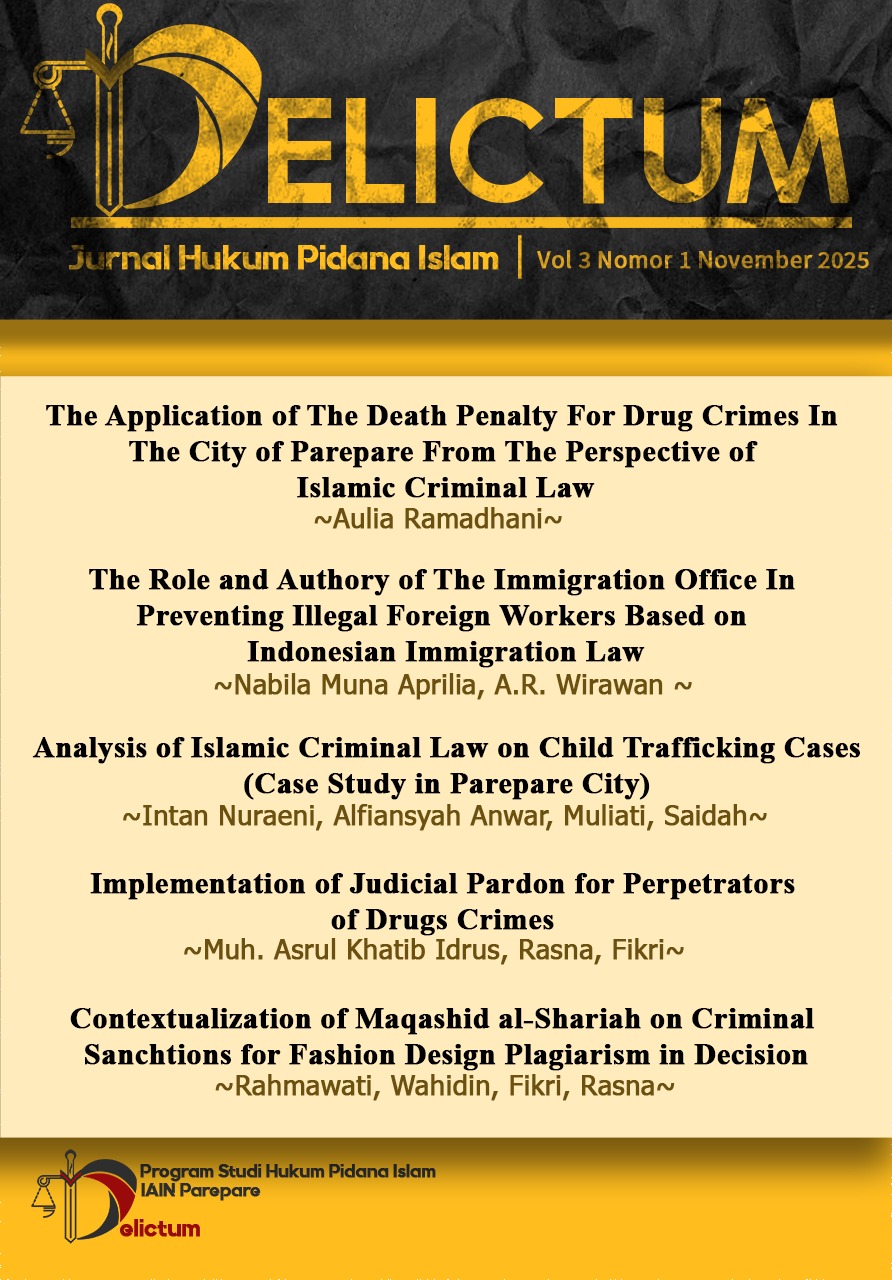
Analisis Hukum Pidana Islam Terhadap Kasus Perdagangan Anak (Studi Putusan Nomor 177/Pid.Sus/2023/PN Pre)
Studi Komparatif Antara Hukum Nasional dan Hukum Pidana Islam dalam Penerapan Teori Pemidanaan
DOI:
https://doi.org/10.35905/delictum.v3i1.15358Kata Kunci:
• Hukum Pidana Islam • Perdagangan Anak • Maqāṣid al-Syarī‘ah • Teori Pemidanaan • Hukum Nasional • Perlindungan Anak • Human TraffickingAbstrak
Penelitian ini mengkaji tiga rumusan masalah utama, yaitu: (1) bagaimana analisis hukum nasional dalam kasus perdagangan anak berdasarkan Putusan Nomor 177/Pid.Sus/2023/PN Pre, (2) bagaimana pandangan hukum pidana Islam terhadap kasus tersebut, dan (3) bagaimana penerapan teori pemidanaan dalam putusan tersebut. Jenis penelitian yang digunakan adalah penelitian lapangan (field research) dengan pendekatan yuridis normatif. Data diperoleh melalui observasi, wawancara, dan dokumentasi, lalu dianalisis secara deskriptif kualitatif. Hasil penelitian menunjukkan bahwa: pertama, sistem hukum nasional telah berupaya menindak pelaku perdagangan anak sesuai Undang-Undang Perlindungan Anak, meskipun vonis masih relatif ringan; kedua, dalam perspektif hukum Islam, perbuatan pelaku tergolong eksploitasi yang diharamkan dan bertentangan dengan prinsip maqāṣid al-syarī‘ah; ketiga, penerapan sanksi dalam putusan mengikuti teori pemidanaan gabungan yang mempertimbangkan keadilan bagi pelaku dan efek jera bagi masyarakat.
This study examines three main issues: (1) the analysis of national law in child trafficking cases based on Decision Number 177/Pid.Sus/2023/PN Pre, (2) the view of Islamic criminal law on the case, and (3) the application of punishment theory in the verdict. This research uses field research with a normative juridical approach. Data were collected through observation, interviews, and documentation, and analyzed qualitatively. The results show that: first, the national legal system has attempted to address child trafficking cases according to the Child Protection Law, although the sentence remains relatively light; second, from an Islamic law perspective, the perpetrator’s act constitutes prohibited exploitation, contrary to the maqāṣid al-syarī‘ah principles; and third, the application of punishment in the decision follows a combined theory considering justice for the perpetrator and deterrence for society.
Referensi
• Arief, Barda Nawawi. 2018. Bunga Rampai Kebijakan Hukum Pidana. Jakarta: Kencana.
• Dermawan, Ari, dan Akmal Akmal. 2020. “Urgensi Perlindungan Hukum Bagi Korban Tindak Pidana dalam Era Teknologi Informasi.” Jurnal Go-Retan Pena 2(2): 39–46.
• Fitra Rachman dan Aida Nurlaili. 2023. “Analisis Efektivitas Penegakan Hukum Tindak Pidana Perdagangan Orang di Indonesia.” Jurnal Hukum dan Pembangunan 53(2).
• Muliati. 2020. “Perlindungan Perempuan dan Anak dalam Perspektif Islam.” Al-Maiyyah 13(2): 145.
• Republik Indonesia. 2007. Undang-Undang Nomor 21 Tahun 2007 tentang Pemberantasan Tindak Pidana Perdagangan Orang.
• Republik Indonesia. 2014. Undang-Undang Nomor 35 Tahun 2014 tentang Perlindungan Anak.
• Restu Permadi. 2025. Wawancara Hakim Pengadilan Negeri Parepare.
• Muslim bin al-Ḥajjāj al-Qusyairī al-Naisabūrī. Ṣaḥīḥ Muslim, No. 2631. Beirut: Dār Ihyā’ al-Turāth al-‘Arabī.
Unduhan
Diterbitkan
Cara Mengutip
Terbitan
Bagian
Lisensi
Authors who publish in this journal agree to the following terms:
1. Authors retain copyright and grant the journal right of first publication with the work simultaneously licensed under a Creative Commons Attribution License that allows others to share the work with an acknowledgment of the work's authorship and initial publication in this journal.
2. Legal formal aspect of journal publication accessibility refers to Creative Commons Attribution 4.0 (CC-BY 4.0). You are free to:
Share — copy and redistribute the material in any medium or format
Adapt — remix, transform, and build upon the material for any purpose, even commercially.
3. Every publication (printed/electronic) is open access for educational purposes, research, and library. Other than the aims mentioned above, the editorial board is not responsible for copyright violation
This work is licensed under a Creative Commons Attribution 4.0 (CC-BY 4.0)




.png)