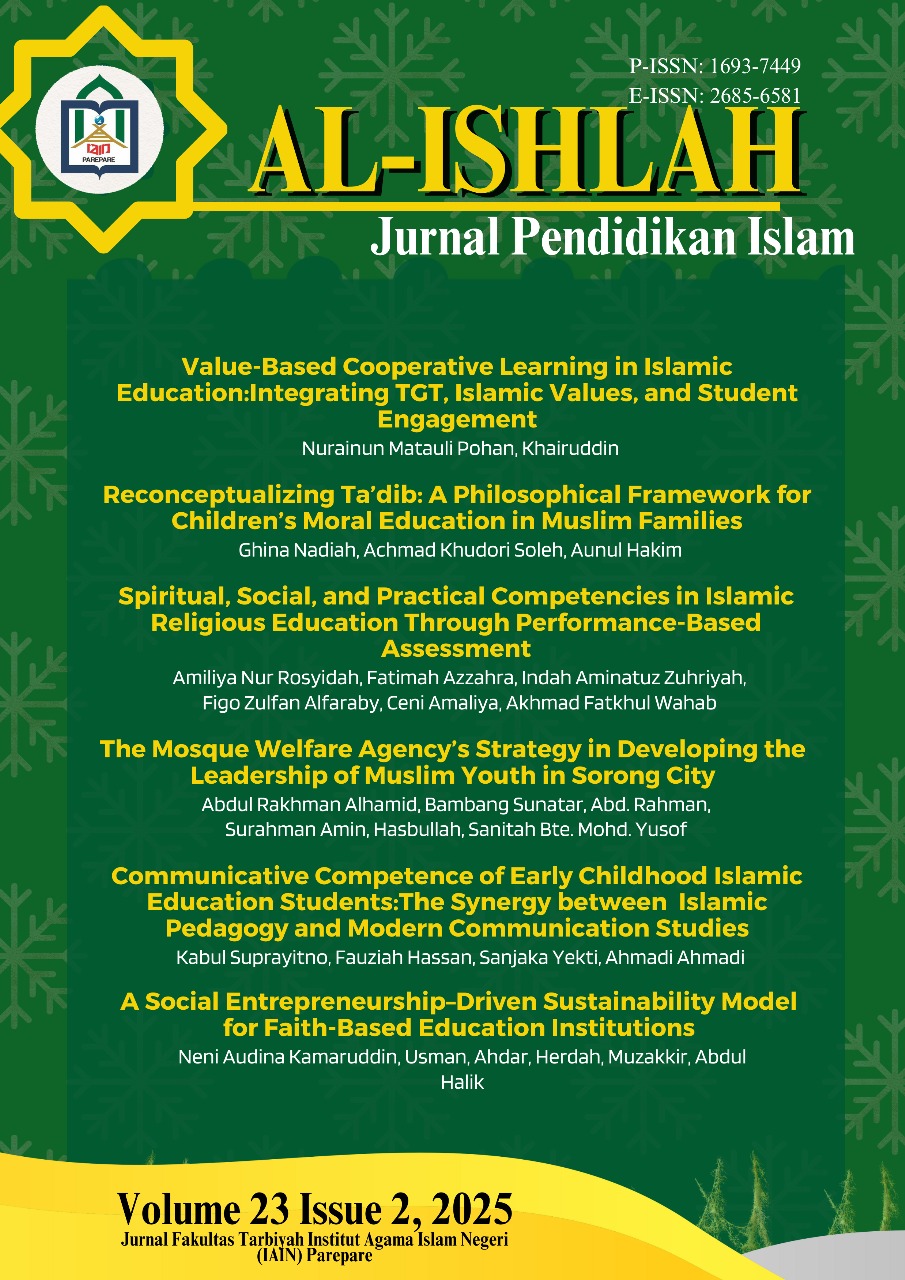
Value-Based Cooperative Learning in Islamic Education: Integrating TGT, Islamic Values, and Student Engagement
DOI:
https://doi.org/10.35905/alishlah.v23i2.14869Keywords:
enthusiasm, Islamic Religious Education, Local Wisdom, Team Games TournamentAbstract
Background: Islamic Religious Education (PAI) often struggles to foster student engagement, as teacher-centered instruction tends to limit participation and enthusiasm. In pluralistic societies such as Indonesia, this challenge is compounded by the need to integrate Islamic values with local wisdom and religious moderation. Cooperative learning models like Team Games Tournament (TGT) have shown promise in promoting collaboration, yet their affective impact on enthusiasm in Islamic education remains underexplored. Research Objectives: This study aims to examine the effect of the TGT learning model on students’ enthusiasm for learning PAI. Specifically, it seeks to test whether TGT enhances cognitive, affective, and behavioral dimensions of enthusiasm while embedding Islamic values, local wisdom, and principles of religious moderation. Methods: A quantitative experimental approach was employed using a one-group pretest–posttest design. The participants were 29 ninth-grade students at SMP Sinar Husni Medan, selected through purposive sampling. Data were collected using a validated 25-item enthusiasm scale covering three dimensions and analyzed with descriptive statistics, Shapiro–Wilk and Levene’s tests, paired-sample t-tests, and Cohen’s d effect size. Results: Findings indicate a statistically significant improvement in enthusiasm after TGT implementation (t = 8.87, p < 0.001; Cohen’s d = 0.78). Gains were strongest in affective enthusiasm (+8.5%), followed by cognitive (+6.1%) and behavioral (+5.7%) dimensions. These results confirm that TGT not only enhances engagement but also enables students to practice values of shura, ukhuwah, and ta‘awun through cooperative interaction, complemented by local wisdom such as dalihan na tolu. Conclusions: The study concludes that TGT significantly improves enthusiasm in PAI by fostering positive emotions, participation, and cultural relevance. Theoretically, it contributes a Value-Based Cooperative Learning Framework that integrates Islamic ethics, local wisdom, and religious moderation into cooperative pedagogy. Practically, the findings suggest that TGT can revitalize Islamic education in pluralistic societies and inspire future comparative studies in both Muslim-majority and minority contexts.
Downloads
References
Fitrianto, I., & Farisi, M. (2025). Integrating Local Wisdom into 21st Century Skills: A Contextual Framework for Culturally Relevant Pedagogy in Rural Classrooms. International Journal of Post Axial: Futuristic Teaching and Learning, 109–121.
Fredricks, J. A. (2022). The measurement of student engagement: Methodological advances and comparison of new self-report instruments. In Handbook of research on student engagement (pp. 597–616). Springer.
Fredricks, J. A., Wang, M.-T., Linn, J. S., Hofkens, T. L., Sung, H., Parr, A., & Allerton, J. (2016). Using qualitative methods to develop a survey measure of math and science engagement. Learning and Instruction, 43, 5–15.
Guna, B. W. K., & Yuwantiningrum, S. E. (2024). Building Morality and Ethics Through Islamic Religious Education In Schools. IJGIE (International Journal of Graduate of Islamic Education), 5(1), 14–24.
Hasibuan, H. A. (2021). Pendidikan Akhlak Islam melalui Kearifan Lokal Dalihan Na Tolu. Tabyin: Jurnal Pendidikan Islam, 3(01), 163–178.
Jackson, R. (2018). Religious education for plural societies: The selected works of Robert Jackson. Routledge.
Johnson, D. W., & Johnson, R. T. (2018). Cooperative learning: The foundation for active learning. Active Learning—Beyond the Future, 59–71.
Kebede, Y. A., Zema, F. K., Geletu, G. M., & Zinabu, S. A. (2024). Unlocking the power of togetherness: Exploring the impact of cooperative learning on peer relationships, academic support, and gains in secondary school biology in gedeo zone South Ethiopia. Science Education International, 35(3), 229–239.
Kementerian Agama. (2019). Moderasi beragama. Jakarta: Badan Litbang Dan Diklat Kementerian Agama RI.
Leganger-Krogstad, H. (2001). Religious education in a global perspective: a contextual approach. Towards Religious Competence: Diversity as a Challenge for Education in Europe, 53–73.
Mala, A., Zulkarnain, Z., Bakar, M. Y. A., & Marpuah, S. (2024). Fostering Tolerance Through Inclusive Islamic Education: The Role of Pesantren in Navigating Global Challenges. Jurnal Pendidikan Agama Islam (Journal of Islamic Education Studies), 12(2), 153–178.
Pai, G., Silberberg, E., & Wamba, N. (2024). Alternative pedagogies to advance equity in undergraduate STEM courses: A systematic review of research. Journal for STEM Education Research, 1–24.
Quin, D. (2017). Longitudinal and contextual associations between teacher–student relationships and student engagement: A systematic review. Review of Educational Research, 87(2), 345–387.
Riyanti, R. F., Suranto, S., Yusof, N., & Febriyanti, A. (2024). Improving learning outcomes and learning motivation of students through teams games tournament learning model (TGT). Jurnal Varidika, 1–12.
Siddique, M. A. (2025). Integrating Cultural Diversity: An Islamic Framework for Multicultural Societies. Journal of Advanced Studies in Social Sciences, 3(1).
Skinner, E. A. (2023). Four guideposts toward an integrated model of academic motivation: Motivational resilience, academic identity, complex social ecologies, and development. Educational Psychology Review, 35(3), 80.
Skinner, E., Pitzer, J., & Brule, H. (2014). The role of emotion in engagement, coping, and the development of motivational resilience. In International handbook of emotions in education (pp. 331–347). Routledge.
Slavin, R. E., Hurley, E. A., & Chamberlain, A. (2003). Cooperative learning and achievement: Theory and research. Handbook of Psychology: Educational Psychology, 7, 177–198.
Utari, U., Soraya, S., & Wulandari, Y. (2024). The gradual Islamisation of teacher education: Current trends and future implications in global inclusive education policy. Journal on Islamic Studies, 1(1), 1–16.
Warsah, I., Morganna, R., Uyun, M., Afandi, M., & Hamengkubuwono, H. (2021). The impact of collaborative learning on learners’ critical thinking skills. International Journal of Instruction, 14(2), 443–460.
Zalukhu, A. (2025). The Implementation of Dalihan Na Tolu Values as Christian Education in Approaching Domestic Violence Conflict Resolution. ETNOREFLIKA: Jurnal Sosial Dan Budaya, 14(2), 295–309.



2.png)
.png)
.png)
.png)
1.png)



.png)