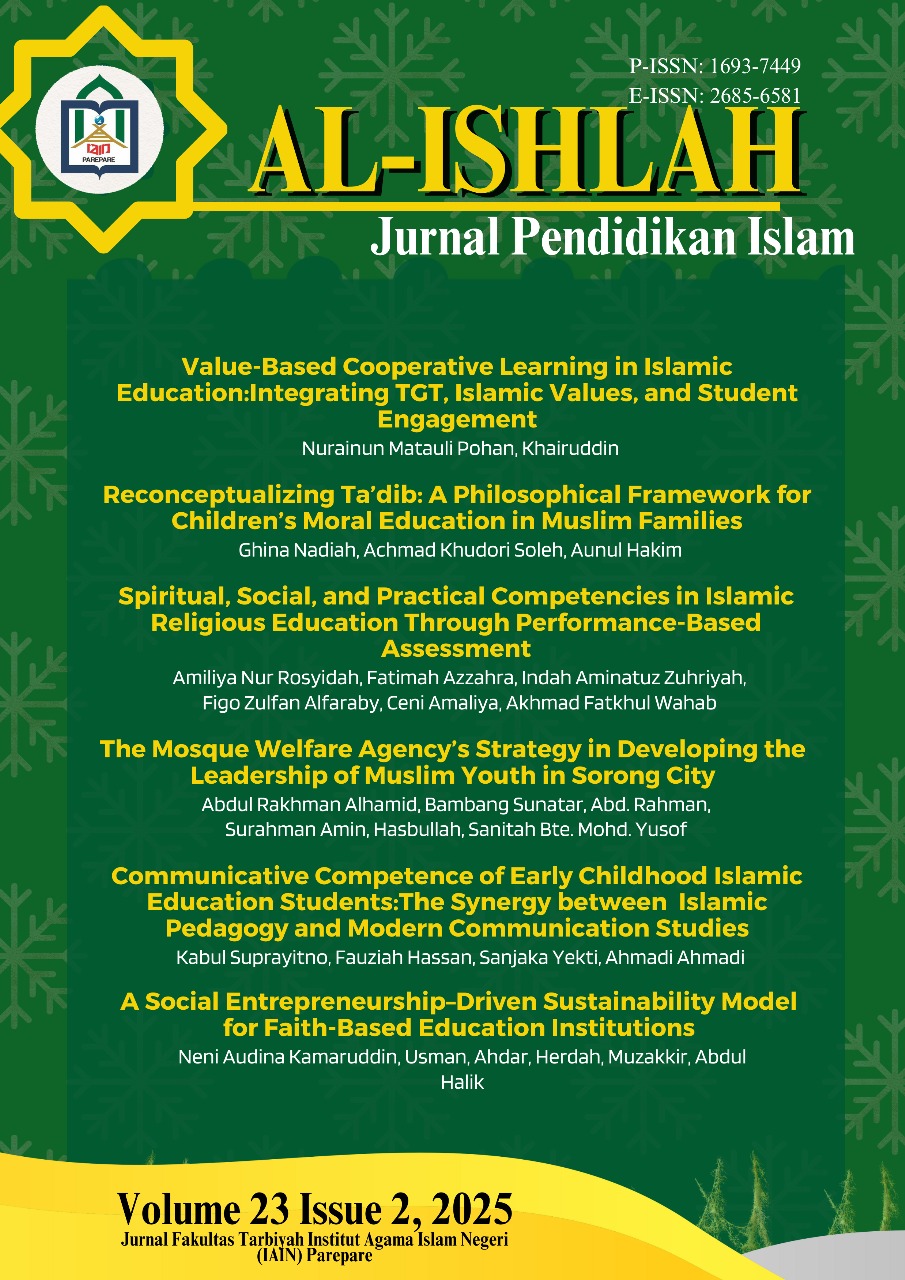
The Mosque Welfare Agency’s Strategy in Developing the Leadership of Muslim Youth in Sorong City
DOI:
https://doi.org/10.35905/alishlah.v23i2.14938Keywords:
mosque welfare agency, mosque youth, Islamic leadership, arts and culture, toleranceAbstract
Background: The Nurul Bahri’s Mosque Welfare Agency (BKM) develops local wisdom leadership in fostering the skills and harmony of the Muslim young generation.Research Objective: This study aims to explore the strategies in fostering Islamic leadership among youth at the Nurul Bahri Mosque in Sorong City, Southwest Papua Province, Indonesia, and its contribution to maintaining a harmonious life. Methods: This qualitative study used interviews, observation, and documentation with six BKM administrators, three mosque youth mentors, and ten purposively selected active youths engaged in leadership, arts, culture, organizational activities, and community development within mosque-based programs. This study collected data over a period of about ten months, from June 2024 to April 2025. Results: The results show that the youth development has advanced from informal activities to structured programs that enhance confidence, leadership, communication, and cultural skills. Islamic arts serve as both a means of religious outreach and a medium for creativity, social legitimacy, and interfaith tolerance. These outcomes differ from Lombok’s predominantly Muslim yet ethnically rooted Sasak culture, Belgium’s highly diverse and secular European population, and Malaysia’s multicultural Malay–Chinese–Indian society. Each demographic context shapes youth engagement and cultural expression differently, making this mosque-based model distinctive. Conclusion: This study concludes that BKM Nurul Bahri Mosque develops an integrative youth model blending spiritual education, skills training, and Islamic arts, recommending mosque adoption and policy support to strengthen youth leadership, cultural engagement, and social harmony in multicultural communities.
Downloads
References
Abduh, A., Basri, M., Rapi, M., & Rosmaladewi, R. (2021). Multicultural engagement activities to support internationalization of bilingual higher education programs. Qualitative Report, 26(10), 3296–3306. https://doi.org/10.46743/2160-3715/2021.5022
Ahmad Amir Aziz, & Miftahul Huda. (2024). Contribution of Islamic University to the Development of Mosque-Based Non-Formal Islamic Education in Lombok, Indonesia. Al-Hayat: Journal of Islamic Education, 8(3), 982–998. https://doi.org/10.35723/ajie.v8i3.677
Arsyad, L. (2023). The Importance of Islamic Values in the Early Childhood Education Curriculum: A Character Education Approach. Journal La Edusci, 03(06), 443–449. https://doi.org/10.37899/journallaedusci.v4i6.922
Ayu Sadewi, & M. Makhrus. (2024). Pembelajaran Pendidikan Agama Islam dan Budi Pekerti Di Sekolah Minoritas Muslim Di SMP Negeri 26 Kabupaten Sorong Papua. WISSEN : Jurnal Ilmu Sosial Dan Humaniora, 2(1), 11–25. https://doi.org/10.62383/wissen.v2i1.39
Creswell, J. W. (2009). Research Design: Qualitative, Quantitative, Mixed Methods Approaches (Third Edition). SAGE Publications, Inc.
Creswell, J. W., & Clark, V. L. P. (2011). Choosing a mixed methods design. In Designing and Conducting Mixed Methods Research (pp. 53–106). Sage Publications, Inc.
Elfrida, R., & Pasaribu, A. N. (2023). Hate Speech on Social Media: A Case Study of Blasphemy in the Indonesian Context. English Review: Journal of English Education, 11(2), 433–440. https://doi.org/10.25134/erjee.v11i2.7909
Farhan, F., Nurwadjah, & Andewi Suhartini. (2022). Masjid Sebagai Basis Pendidikan Non Formal. Jurnal Al-Qalam: Jurnal Kajian Islam & Pendidikan, 14(1), 46–57. https://doi.org/10.47435/al-qalam.v14i1.630
Hamzah, H., Yudiawan, A., Umrah, S., & Hasbullah, H. (2020). Islamic Economic Development in Indonesian Islamic higher education. International Journal of Evaluation and Research in Education, 9(1), 77–82. https://doi.org/10.11591/ijere.v9i1.20317
Hanafi, M. and W. (2025). Pendampingan Pendidikan Karakter pada Peserta Didik Madrasah Aliyah Nahdlatul Ummah Ponorogo. Social Science Academic, 3(1), 77–82. https://doi.org/10.37680/ssa.v3i1.7835
Hidayat [email protected], E. R., Danuri [email protected], H., & Purwanto [email protected], Y. (2018). Eco Masjid: the First Milestone of Sustainable Mosque in Indonesia. Journal of Islamic Architecture, 5(1), 20–26. http://10.0.73.172/jia.v5i1.4709%0Ahttps://search.ebscohost.com/login.aspx?direct=true&db=asu&AN=131014669&site=ehost-live
Hidayati, U. (2015). Penyelenggaraan Madrasah Di Daerah Minoritas Muslim. EDUKASI: Jurnal Penelitian Pendidikan Agama Dan Keagamaan, 13, 269–290. https://doi.org/10.32729/edukasi.v13i2.243
Ipa Salma Alhamid; Indria Nur; Hasbullah. (2024). Internalisasi Nilai-Nilai Pendidikan Islam dalam Pembentukan Karakter pada Peserta Didik di SD Inpres 2 Wagom. TRANSFORMASI: Jurnal Kepemimpinan Dan Pendidikan Islam, 7(2), 29–56. http://e-jurnal.iainsorong.ac.id/index.php/Transformasi/article/view/1550
Lambert, C., Aubrey, S., Lambert, C., & Aubrey, S. (2025). Learner-generated content , task engagement , affective response , and memory on technology-mediated conversation tasks. Studies in Second Language Learning and Teaching, 15(1), 1–22. https://doi.org/https://doi.org/10.14746/ssllt.42079
Lingu, A., & Makassar, U. M. (2025). Mobile Assisted Language Learning ( MALL ) on EFL Students’ Writing Proficiency at Universitas. SMART (Journal of English Language Teaching and Applied Linguistics), 11(2), 274–290. https://doi.org/https://ejournal.stkipmpringsewu-lpg.ac.id/index_php/smart/about/editorialPolicies#custom-1
M. Andy Hermansyah. (2024). Implementasi Pendidikan Karakter Islami Melalui Program Kegiatan Sekolah Berbasis Masjid SD IT Cahaya Robbani Kabupaten Kepahiang. Berkala Ilmiah Pendidikan, 4(3), 478–490. https://doi.org/DOI: https://doi.org/10.51214/bip.v4i3.1050
Madya, S. (2015). Searching for an Appropriate Efl Curriculum Design for the Indonesian Pluralistic Society. TEFLIN Journal - A Publication on the Teaching and Learning of English, 18(2), 196. https://doi.org/10.15639/teflinjournal.v18i2/196-221
Manshur, U., & Munif, M. (2023). Harmony within Diversity : The Internalization of Religious Moderation as a Pillar in Sustaining National Identity. Jurnal Islam Nusantara, 07(1), 56–69.
Mataputun, Y. (2020). Analisis pemenuhan standar nasional pendidikan dan permasalahannya. Jurnal Konseling Dan Pendidikan, 8(3), 224. https://doi.org/10.29210/148800
Muhammad Arbain, Gusniati, Y., Tamam, B., Fadilah, N., & Syaiful. (2024). Implementation of Child-Friendly School in the Perspective of Islamic Religious Education in Elementary Schools in North Kalimantan. Al-Ishlah: Jurnal Pendidikan Islam, 22(2), 103–120. https://doi.org/10.35905/alishlah.v22i2.10680
Muhammad, Hasbullah, Syarifudin, & Patak, A. A. (2019). Implementation of English subject curriculum in Islamic secondary schools in Indonesia using Delphi method. XLinguae, 12(4), 143–154. https://doi.org/10.18355/XL.2019.12.04.12
Nur, I. (2022). Religious Education Based Of Local Wisdom “Satu Tungku Tiga Batu” In Fak-Fak Community West Papua. AL-ISHLAH: Jurnal Pendidikan, 14(4), 6631–6642. https://doi.org/10.35445/alishlah.v14i4.2267
Nurkanti, M., Santiago, P. V. da S., Yasundari, Y., & Rohimah, S. M. (2023). Developing students’ critical thinking abilities using the English literacy comprehension Journal: A case study in Biology Education. AMCA Journal of Science and Technology, 3(2), 43–46. https://doi.org/10.51773/ajst.v3i2.295
Rohmawati, W. S. A., & Hamidah, K. (2025). Religious Tolerance Narratives on Social Media: Network Analysis of Indonesian Civil Society Organizations on Instagram (2019–2023). Islamic Review: Jurnal Riset Dan Kajian Keislaman, 14(1), 1–26. https://doi.org/10.35878/islamicreview.v14i1.1517
Roza, E. (2023). Exemplifying the Behaviour of the Prophet Muhammad Saw: An Approach to Islamic Character Education. EDUKASI: Jurnal Pendidikan Islam (e …. https://ejournal.staim-tulungagung.ac.id/index.php/edukasi/article/view/401%0Ahttps://ejournal.staim-tulungagung.ac.id/index.php/edukasi/article/download/401/319
Safitri Nuril, Kaunain; Hasbullah; and Abd. Rahman. (2025). The Effectiveness of Podcasts on YouTube as a Learning Media in Improving Students’ Listening Skills. IJoASER: International Journal on Advanced Science, Education, and Religion, 8(1), 277–293. https://doi.org/DOI: https://doi.org/10.33648/ijoaser.v8i2.856
Sarwono, J. (2011). Mixed Methods: Cara Menggabung Riset Kuantitatif dan Riset Kualitatif secara Benar (Pertama). PT. Gramedia.
Sony Eko Adisaputro, Sutamaji, & Muhammad Amrillah. (2021). Peran Remaja Masjid dalam Meningkatkan Dakwah. J-KIs: Jurnal Komunikasi Islam, 2(1), 43–52. https://doi.org/10.53429/j-kis.v2i1.227
Suhail, A. K., Lintang, D., Pahrudin, A., & Oktaviano, W. (2025). Azyumardi Azra dan Moderasi Beragama di Indonesia. Al Qalam: Jurnal Ilmiah Keagamaan Dan Kemasyarakatan, 19(2), 737–754. https://doi.org/DOI : 10.35931/aq.v19i2.4179
Suherman, I., Fauziah, S. P., Roestamy, M., Bilad, M. R., Amirullah, A., & Nandiyanto, A. B. D. (2023). How to Improve Student Understanding in Learning Science by Regulating Strategy in Language Education ? Definition, Factors for Enhancing Students' Comprehension, and Computational Bibliometric Review Analysis. International Journal of Language Education, 7(3), 527–562.
Sulaeman, A. R. (2019). Peran Guru Pendidikan Agama Islam dalam Membentuk Akhlak Terpuji Peserta Didik di UPTD Negeri 9 Parepare. Prosiding, 2(1), 1–10. http://lp3.um.ac.id/wp-content/uploads/simple-file-list/Prosiding-Semnas-PAI.pdf#page=38http://www.issn.lipi.go.id/issn.cgi?daftar&1493781343&1&&
Ta’ba’, Y., Rabia, S. F., & Yulianto, A. (2024). Turning a New Page: Using Pop-up Books to Motivate Students with Learning Disabilities. Utamax : Journal of Ultimate Research and Trends in Education, 6(1), 33–43. https://doi.org/10.31849/utamax.v6i1.16825
Tang, M., Hasbullah, H., & Sudirman, S. (2018). Cultural Diversity in Al-Qur’an Perspective. International Journal on Advanced Science, Education, and Religion, 1(2), 27–34. https://doi.org/10.33648/ijoaser.v1i2.11
Uktolseja, L. J., Manuhutu, M. A., & Pakpahan, R. R. (2023). PACE-Learning uses Local Culture-Based Learning Videos for KMBKS Association Youth. Jurnal Dinamisia, 7(Desember), 1753–1761.
Wirakusumah, I. A. F. I. (2022). The dynamics of meaning in mosque architecture: A case study of old and modern mosques in West Java Indonesia. ARTEKS : Jurnal Teknik Arsitektur, 7(1), 143–154. https://doi.org/10.30822/arteks.v7i1.1457
Wiyono, B. (2019). Hakikat Kepemimpinan Transformasional Kepemimpinan. Jurnal Manajemen Pendidikan Islam, 2, 75–83. https://www.kompasiana.com/idrisapandi/58fb8125349373880b4c289e/hakikat-kepemimpinan
Xhomara, N., & Shkembi, F. (2020). The influence of multiple intelligences on learning styles in teaching and learning. Journal of Applied Technical and Educational Sciences JATES, 10(1), 19–48.
Yaumi, M., Sirate, S. F. S., & Patak, A. A. (2018). Investigating Multiple Intelligence-Based Instructions Approach on Performance Improvement of Indonesian Elementary Madrasah Teachers. SAGE Open, 8(4). https://doi.org/10.1177/2158244018809216



2.png)
.png)
.png)
.png)
1.png)




.png)