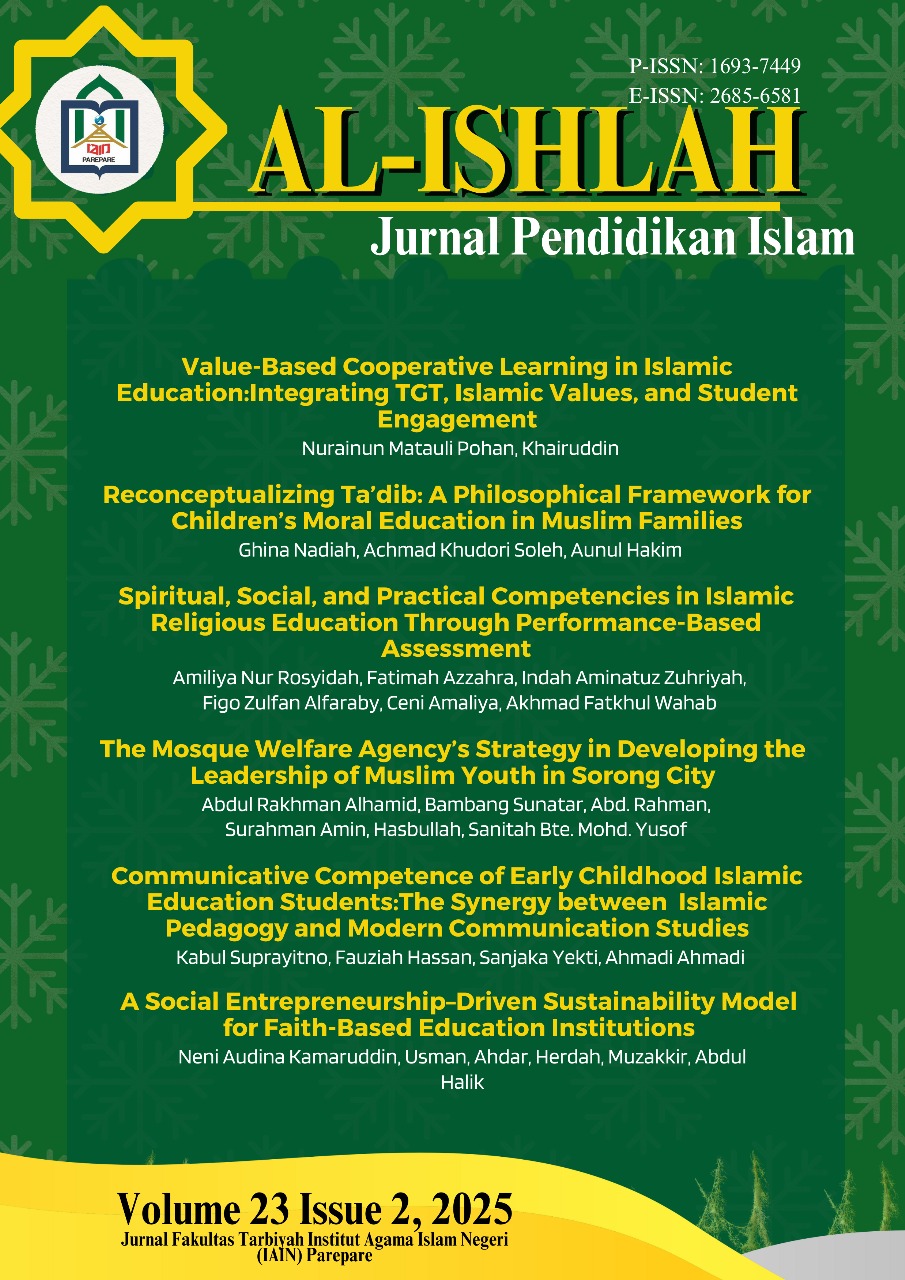
Communicative Competence of Early Childhood Islamic Education Students: The Synergy between Islamic Pedagogy and Modern Communication Studies
DOI:
https://doi.org/10.35905/alishlah.v23i2.15243Keywords:
communicative competence, Islamic pedagogy, PIAUD students, communication theory, educative communicationAbstract
Background:Recent scholarship highlights communicative competence as a foundational dimension of teacher professionalism; however, within Islamic Early Childhood Education, its conceptualization remains fragmented, often limited to surface-level linguistic or performative skills. This narrow treatment obscures the ethical, dialogic, and digital dimensions necessary for cultivating educators capable of navigating contemporary pedagogical demands while remaining grounded in Islamic value frameworks. Research Objectives:This study investigates the multidimensional constitution of communicative competence among prospective Islamic early childhood teachers and seeks to theorize an integrative framework, Islamic Educommunication Competence—that synthesizes spiritual–moral ethics, dialogic interaction, and critical digital literacy. Methods: Using an interpretivist qualitative design, data were collected from 60 participants through semi-structured interviews, sustained classroom observations, and document analysis of teaching artifacts. A hybrid inductive–deductive thematic analysis was applied, supported by iterative coding validation and intercoder reliability to ensure analytic rigor. Results: The analysis reveals that communicative competence emerges through three interdependent domains: (1) ethical–spiritual orientation, characterized by adab, sincerity, and moral intentionality; (2) dialogic and sociocultural mediation, reflected in collaborative reasoning, reflective discourse, and contextual sensitivity shaped by local Islamic cultural practices; and (3) critical digital engagement, which enables ethical, multimodal, and audience-responsive communication. Together, these domains articulate a theoretical expansion of communicative competence beyond linguistic ability. Conclusions: The study advances a conceptual model of Islamic Educommunication Competence that repositions communicative ability as an ethical–dialogic construct embedded within digital ecologies. This model offers significant implications for teacher education curricula seeking to integrate Islamic ethics with contemporary communication practices. Future research should examine the model’s transferability across broader Islamic education contexts and its empirical impact on classroom outcomes.
Downloads
References
Alkouatli, C. (2023). “We’re Trying to Raise Muslim Kids, Right?” Muslim Educators’ Narratives of Human Development. Cognition and Instruction, 41(1), 32–60. https://doi.org/10.1080/07370008.2022.2073355
Azman, N. A., Hamzah, M. I., & Abd Razak, K. (2025). DIGITAL INTEGRATION IN PRIMARY SCHOOL ISLAMIC EDUCATION: TEACHERS’ PERSPECTIVES ON ITS IMPACT ON STUDENTS’ LEARNING. Malaysian Journal of Learning and Instruction, 22(2), 140–160. https://doi.org/10.32890/mjli2025.22.2.7
Bakti, I. K., Kurniawan, R., Mukhlishah, Mudlofir, A., Kusaeri, & Bahri, R. (2025). Integrating Islamic values in inclusive madrasa education: a unique approach for special needs students. International Journal of Inclusive Education, 1–17. https://doi.org/10.1080/13603116.2025.2555397
Biesta, G. (2023). Becoming contemporaneous: intercultural communication pedagogy beyond culture and without ethics. Pedagogy, Culture & Society, 31(2), 237–251. https://doi.org/10.1080/14681366.2022.2164341
Blaj-Ward, L., & Winter, K. (2019). Engaging students as digital citizens. Higher Education Research & Development, 38(5), 879–892. https://doi.org/10.1080/07294360.2019.1607829
Braun, V., & Clarke, V. (2019). Reflecting on reflexive thematic analysis. Qualitative Research in Sport, Exercise and Health, 11(4), 589–597. https://doi.org/10.1080/2159676X.2019.1628806
Churchill, N. (2020). Development of students’ digital literacy skills through digital storytelling with mobile devices. Educational Media International, 57(3), 271–284. https://doi.org/10.1080/09523987.2020.1833680
Creswell, J. W., Creswell, J. D. (2018). A Mixed-Method Approach. In Writing Center Talk over Time. https://doi.org/10.4324/9780429469237-3
Cui, R., & Teo, P. (2021). Dialogic education for classroom teaching: a critical review. Language and Education, 35(3), 187–203. https://doi.org/10.1080/09500782.2020.1837859
Díaz, A. R. (2018). Dialogic pedagogy: the importance of dialogue in teaching and learning. Language and Intercultural Communication, 18(2), 277–279. https://doi.org/10.1080/14708477.2017.1287116
Didikin, A., & Shumilova, E. (2025). Education as a way of forming the ethical virtues: al-Farabi's philosophy and classical tradition. Schole Ancient Philosophy and the Classical Tradition, 19(2). https://doi.org/10.25205/1995-4328-2025-19-2-1131-1139
Dooly, M., & Darvin, R. (2022). Intercultural communicative competence in the digital age: critical digital literacy and inquiry-based pedagogy. Language and Intercultural Communication, 22(3), 354–366. https://doi.org/10.1080/14708477.2022.2063304
Ganjvar, M. (2019). Islamic Model of Children’s Spiritual Education (CSE); its influence on improvement of communicational behaviour with non-coreligionists. International Journal of Children’s Spirituality, 24(2), 124–139. https://doi.org/10.1080/1364436X.2019.1624254
Gao, F. (2024). Taking innovative humanising pedagogy towards Thirdness: sustaining the development of intercultural competence. Language and Intercultural Communication, 24(2), 118–136. https://doi.org/10.1080/14708477.2024.2328157
Guzmán, V., & Larrain, A. (2024). The transformation of pedagogical practices into dialogic teaching: towards a dialogic notion of teacher learning. Professional Development in Education, 50(4), 716–729. https://doi.org/10.1080/19415257.2021.1902837
Karwadi, Bin Zakaria, A. R., Setiyawan, A., & Ferdi Hasan, M. (2025). Integration of critical pedagogy in Islamic education: a case study of pre-service teacher training. British Journal of Religious Education, 1–22. https://doi.org/10.1080/01416200.2025.2560905
Khamis, S. (2024). The Paradoxes of Modern Islamic Discourses and Socio-Religious Transformation in the Digital Age. Religions, 15(2), 207. https://doi.org/10.3390/rel15020207
Lefstein, A., Pollak, I., & Segal, A. (2020). Compelling student voice: dialogic practices of public confession. Discourse: Studies in the Cultural Politics of Education, 41(1), 110–123. https://doi.org/10.1080/01596306.2018.1473341
Luligo Espinal, J. S., Carmona Alvarado, F. A., & Barrientos Gutiérrez, P. (2024). La convivencia escolar y la ética del cuidado: percepción de docentes de educación secundaria. Sophia, 20(2). https://doi.org/10.18634/sophiaj.20v.2i.1427
Mata-McMahon, J., Haslip, M. J., & Schein, D. L. (2019). Early childhood educators’ perceptions of nurturing spirituality in secular settings. Early Child Development and Care, 189(14), 2233–2251. https://doi.org/10.1080/03004430.2018.1445734
Mu’ti, A. (2023). Pluralistic Islamic Religious Education: A Vision for Indonesia. The Review of Faith & International Affairs, 21(2), 121–127. https://doi.org/10.1080/15570274.2023.2200280
Pallathadka, H., Al-Hawary, S. I. S., Muda, I., Surahman, S. H., Al-Salami, A. A. A., & Nasimova, Z. (2023). The study of Islamic teachings in education: With an emphasis on behavioural gentleness. HTS Teologiese Studies / Theological Studies, 79(1). https://doi.org/10.4102/hts.v79i1.8193
Parks, E. (2018). Communicative criticality and savoir se reconnaître : emerging new competencies of criticality and intercultural communicative competence. Language and Intercultural Communication, 18(1), 107–124. https://doi.org/10.1080/14708477.2017.1401691
Ryu, D., & Jeong, J. (2019). Two Faces of Today’s Learners: Multiple Identity Formation. Journal of Educational Computing Research, 57(6), 1351–1375. https://doi.org/10.1177/0735633118791830
Saputra, A., & Asbi, E. A. (2025). Islam, Big Data, and Digital Ethics: Challenges in Religious Life in the Digital Age. Pharos Journal of Theology, 106.4. https://doi.org/10.46222/pharosjot.106.4022
Sijamhodžić-Nadarević, D. (2024). Philosophy and Pedagogy of Islamic Education in Today’s Europe. Journal of Muslims in Europe, 13(3), 365–378. https://doi.org/10.1163/22117954-bja10106
Smith, D. I. (2019). Researching digital life together. International Journal of Christianity & Education, 23(2), 145–149. https://doi.org/10.1177/2056997119843105
Supriyono, Sumintono, B., & Hakim, L. N. (2025). Critical Islamic educational leadership: investigating how Islamic pedagogic models shape leadership practices. British Journal of Religious Education, 1–18. https://doi.org/10.1080/01416200.2025.2542225
Taubner, H., Andersson, P., & Rampazzo-Gambarato, R. (2025). The multifaceted landscape of educommunication: a scoping review. Communication & Society. https://doi.org/10.15581/003.38.2.012
Utami, V. (2019). Teacher’s Difficulties in Teaching Oral Communication Skills in Indonesia: A Comparative Literature Review. Linguists : Journal of Linguistics and Language Teaching, 5(2), 16. https://doi.org/10.29300/ling.v5i2.4921
Vrikki, M., Brindley, S., Abedin, M., & Riga, F. (2019). Exploring dialogic space: a case study of a religious education classroom. Language and Education, 33(5), 469–485. https://doi.org/10.1080/09500782.2019.1604741
Zeshan, M. (2022). 66.4 Powerful Conversations Between a Father and a Religious Scholar: Lessons From Islamic Teaching. Journal of the American Academy of Child & Adolescent Psychiatry, 61(10), S90–S91. https://doi.org/10.1016/j.jaac.2022.07.376



2.png)
.png)
.png)
.png)
1.png)




.png)