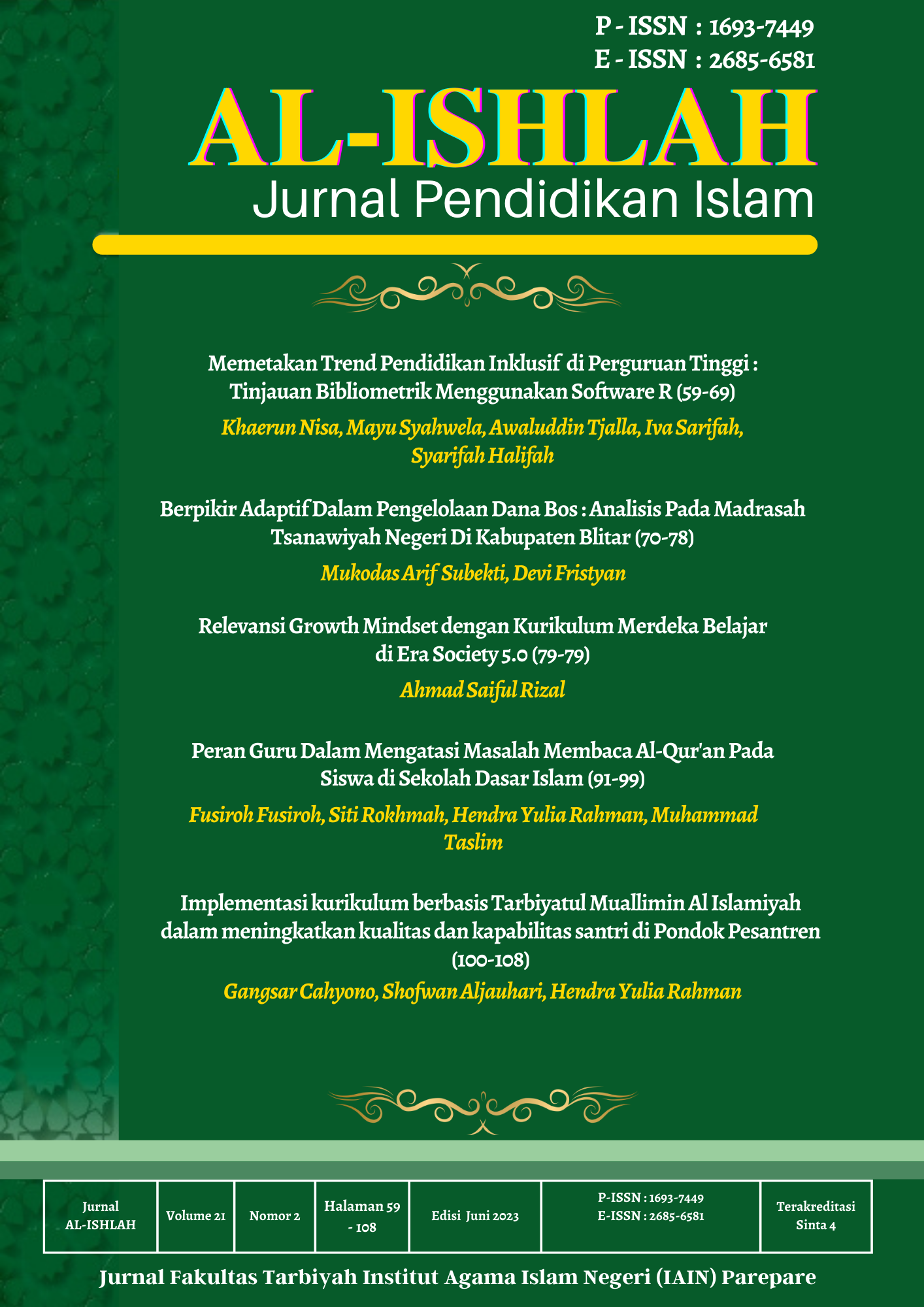
Mapping The Trends Of Inclusive Education In Higher Education: A Bibliometric Review Using R Software
DOI:
https://doi.org/10.35905/alishlah.v21i2.7283Keywords:
Bibliometric Analysis, Higher Education, Inclusive EducationAbstract
Inclusive education in higher education, is vital for creating a diverse and equitable learning environment, ensuring equal opportunities for individuals with diverse abilities and backgrounds. This approach enriches the overall educational experience, fostering global readiness in students for a diverse society. This article utilizes bibliometric analysis with R software to track trends in studies concerning the integration of inclusive education in higher education, drawing data from the Scopus database spanning 2013 to 2023. The findings reveal that the growth of scholarly publications on the implementation of inclusive education in higher education experiences fluctuations. The Sustainability Journal (Switzerland) emerges as the most prolific publisher of articles on this subject, with the University of Nottingham being the most productive affiliate. The United States stands out as the most productive country, and the article titled "Sustainability Strategy in Higher Education Institutions: Lessons Learned from a Nine-Year Case Study" by Ramisio et al. holds the distinction of being the most cited. This research outlines inclusive education in higher education for interested scholars, emphasizing current challenges and potential opportunities in implementing it, particularly in Islamic higher education. The article acknowledges limitations that could be addressed through broader metadata sources and a more extended publication timeline. Furthermore, the novelty of this research is no previous researcher has explored inclusive education in higher education using bibliometric analysis.
Downloads
References
Alryalat, S. A. S., Malkawi, L. W., & Momani, S. M. (2019). Comparing bibliometric analysis using pubmed, scopus, and web of science databases. Journal of Visualized Experiments, 2019(152). https://doi.org/10.3791/58494
Anshory, I. (2018). SWOT Analysis on Inclusive Education in Indonesia. Advances in Social Science, Education and Humanities Research, 231.
Argento, D. (2020). Integrating sustainability in higher education: a Swedish case. International Journal of Sustainability in Higher Education, 21(6), 1131–1150. https://doi.org/10.1108/IJSHE-10-2019-0292
Bartz, J. (2020). All inclusive?! empirical insights into individual experiences of students with disabilities and mental disorders at german universities and implications for inclusive higher education. Education Sciences, 10(9), 1–25. https://doi.org/10.3390/educsci10090223
Bunbury, S. (2020). Disability in higher education–do reasonable adjustments contribute to an inclusive curriculum? International Journal of Inclusive Education, 24(9), 964–979. https://doi.org/10.1080/13603116.2018.1503347
Choy, L. H. T. (2017). The role of higher education in China’s inclusive urbanization. Cities, 60, 504–510. https://doi.org/10.1016/j.cities.2016.04.008
Clouder, L. (2019). The role of assistive technology in renegotiating the inclusion of students with disabilities in higher education in North Africa. Studies in Higher Education, 44(8), 1344–1357. https://doi.org/10.1080/03075079.2018.1437721
Dalton, E. M. (2019). Inclusion, universal design and universal design for learning in higher education: South Africa and the United States. African Journal of Disability, 8. https://doi.org/10.4102/ajod.v8i0.519
Dervis, H. (2019). Bibliometric analysis using bibliometrix an R package. Journal of Scientometric Research, 8(3), 156–160. https://doi.org/10.5530/JSCIRES.8.3.32
Devkota, K. R. (2021). Inequalities reinforced through online and distance education in the age of COVID-19: The case of higher education in Nepal. International Review of Education, 67(1), 145–165. https://doi.org/10.1007/s11159-021-09886-x
Donthu, N., S. Kumar, D. Mukherjee, N. Pandey, & W. M. Lim. (2021). How to conduct a bibliometric analysis: An overview and guidelines. Journal of Business Research , 133, 285–296. https://doi.org/doi: 10.1016/j.jbusres.2021.04.070.
Emmers, E. (2020). Attitudes and self-efficacy of teachers towards inclusion in higher education. European Journal of Special Needs Education, 35(2), 139–153. https://doi.org/10.1080/08856257.2019.1628337
Fuentes, M. A. (2021). Rethinking the Course Syllabus: Considerations for Promoting Equity, Diversity, and Inclusion. Teaching of Psychology, 48(1), 69–79. https://doi.org/10.1177/0098628320959979
Gibson, S. (2015). When rights are not enough: What is? Moving towards new pedagogy for inclusive education within UK universities. International Journal of Inclusive Education, 19(8), 875–886. https://doi.org/10.1080/13603116.2015.1015177
Hewett, R. (2017). Developing an inclusive learning environment for students with visual impairment in higher education: progressive mutual accommodation and learner experiences in the United Kingdom. European Journal of Special Needs Education, 32(1), 89–109. https://doi.org/10.1080/08856257.2016.1254971
Hewett, R. (2020). Balancing inclusive design, adjustments and personal agency: progressive mutual accommodations and the experiences of university students with vision impairment in the United Kingdom. International Journal of Inclusive Education, 24(7), 754–770. https://doi.org/10.1080/13603116.2018.1492637
Ismail, A. (2022). Web accessibility investigation and identification of major issues of higher education websites with statistical measures: A case study of college websites. Journal of King Saud University - Computer and Information Sciences, 34(3), 901–911. https://doi.org/10.1016/j.jksuci.2019.03.011
Jivet, I. (2020). From students with love: An empirical study on learner goals, self-regulated learning and sense-making of learning analytics in higher education. Internet and Higher Education, 47. https://doi.org/10.1016/j.iheduc.2020.100758
Kaliisa, R. (2019). Mobile learning policy and practice in Africa: Towards inclusive and equitable access to higher education. Australasian Journal of Educational Technology, 35(6), 1–14. https://doi.org/10.14742/ajet.5562
Killpack, T. L. (2016). Toward inclusive STEM classrooms: What personal role do faculty play? CBE Life Sciences Education, 15(3). https://doi.org/10.1187/cbe.16-01-0020
Lee, H. Y. (2022). Research on Technological Pedagogical and Content Knowledge: A Bibliometric Analysis From 2011 to 2020. Frontiers in Education, 7. https://doi.org/10.3389/feduc.2022.765233
Lee, J. (2014). Education hubs and talent development: policymaking and implementation challenges. Higher Education, 68(6), 807–823. https://doi.org/10.1007/s10734-014-9745-x
MacLachlan, M. (2018). Assistive technology policy: a position paper from the first global research, innovation, and education on assistive technology (GREAT) summit. Disability and Rehabilitation: Assistive Technology, 13(5), 454–466. https://doi.org/10.1080/17483107.2018.1468496
Meskhi, B. (2019a). E-learning in higher inclusive education: needs, opportunities and limitations. International Journal of Educational Management, 33(3), 424–437. https://doi.org/10.1108/IJEM-09-2018-0282
Meskhi, B. (2019b). E-learning in higher inclusive education: needs, opportunities and limitations. International Journal of Educational Management, 33(3), 424–437. https://doi.org/10.1108/IJEM-09-2018-0282
Moral-Muñoz, J. A., Herrera-Viedma, E., Santisteban-Espejo, A., & Cobo, M. J. (2020). Software tools for conducting bibliometric analysis in science: An up-to-date review. In Profesional de la Informacion (Vol. 29, Issue 1). El Profesional de la Informacion. https://doi.org/10.3145/epi.2020.ene.03
Moriña, A. (2017). Inclusive education in higher education: challenges and opportunities. European Journal of Special Needs Education, 32(1), 3–17. https://doi.org/10.1080/08856257.2016.1254964
Muhuri, P. K., Shukla, A. K., & Abraham, A. (2019). Industry 4.0: A bibliometric analysis and detailed overview. Engineering Applications of Artificial Intelligence, 78, 218–235. https://doi.org/10.1016/j.engappai.2018.11.007
Navarro-Mateu, D. (2019). To be or not to be an inclusive teacher: Are empathy and social dominance relevant factors to positive attitudes towards inclusive education? PLoS ONE, 14(12). https://doi.org/10.1371/journal.pone.0225993
Pichardo, J. I. (2021). Students and teachers using mentimeter: Technological innovation to face the challenges of the covid-19 pandemic and post-pandemic in higher education. Education Sciences, 11(11). https://doi.org/10.3390/educsci11110667
Ramísio, P. J. (2019). Sustainability Strategy in Higher Education Institutions: Lessons learned from a nine-year case study. Journal of Cleaner Production, 222, 300–309. https://doi.org/10.1016/j.jclepro.2019.02.257
Rillotta, F. (2020). Inclusive university experience in Australia: Perspectives of students with intellectual disability and their mentors. Journal of Intellectual Disabilities, 24(1), 102–117. https://doi.org/10.1177/1744629518769421
Ryan, J. B. (2019). Employment and independent living outcomes of a mixed model post-secondary education program for young adults with intellectual disabilities. Journal of Vocational Rehabilitation, 50(1), 61–72. https://doi.org/10.3233/JVR-180988
Saloviita, T. (2018). How common are inclusive educational practices among Finnish teachers? International Journal of Inclusive Education, 22(5), 560–575. https://doi.org/10.1080/13603116.2017.1390001
Sharma, U. (2018). In-service teachers’ attitudes, concerns, efficacy and intentions to teach in inclusive classrooms: an international comparison of Australian and Italian teachers. European Journal of Special Needs Education, 33(3), 437–446. https://doi.org/10.1080/08856257.2017.1361139
Tilak, J. B. G. (2015). How Inclusive Is Higher Education in India? Social Change, 45(2), 185–223. https://doi.org/10.1177/0049085715574178
Walker, M. (2017). Universities, employability and human development. Universities, Employability and Human Development, 1–248. https://doi.org/10.1057/978-1-137-58452-6
Wani, J. A. (2022). The scientific outcome in the domain of grey literature: bibliometric mapping and visualisation using the R-bibliometrix package and the VOSviewer. Library Hi Tech. https://doi.org/10.1108/LHT-01-2022-0012
White, S. (2014). Campus sustainability plans in the United States: Where, what, and how to evaluate? International Journal of Sustainability in Higher Education, 15(2), 228–241. https://doi.org/10.1108/IJSHE-08-2012-0075
Zhao, L. (2021). Innovative Pedagogy and Design-Based Research on Flipped Learning in Higher Education. Frontiers in Psychology, 12. https://doi.org/10.3389/fpsyg.2021.577002


2.png)
.png)
.png)
.png)
1.png)



.png)